Wednesday, 9 April 2014

GCSE chemistry unit 1 - fractional distilation of air

Fractional distillation of the air

Today the air is a mixture of:
  • 78% nitrogen
  • 21% oxygen
  • And 1% other gases (including 0.04% carbon dioxide and 0.8% argon - a noble gas)
Fractional distillation

The air is cooled to -200 degrees so all the gases in the air are condensed into a liquid. Carbon dioxide and water are then removed so we are left with the other gases including nitrogen, argon and oxygen, which all have different boiling points. Heating it to a hoc her temperature each time, nitrogen evaporates first, then argon, then oxygen which can be collected as three different substances.

Uses of argon
  • Unreactive so used inside filament bulb and fluorescent tubes
  • Preserving old document because they are so unreactive.
Uses of nitrogen
  • Food packaging to stop food decomposing (unreactive)
  • In liquid form it can preserve living cells
  • Fertilisers
Uses of oxygen
  • Part of fuels for rockets
  • Oxygen masks etc.

GCES chemistry unit 1 - Miller-Urey experiment

Miller-Urey experiment

Miller and Urey were two scientists who set up apparatus that recreated the conditions that were in the atmosphere 4.5 billion years ago to try and work out how organisms could have been created. 

Water was heated to create water vapour which travelled to a flask containing ammonia, hydrogen and methane. They used a series of different electric shocks on the flask and then condensed the gasses. Within a week, they found they had produced the organic chemicals needed for life such as amino acids. But how these organic chemicals turned into life, still remains unanswered, they won a Nobel Prize for their discoveries.

GCES chemistry unit 1 - the development of the Earth's atmosphere

The development of the Earth's atmosphere

Volcanic eruptions 4.5 billion years ago gave off carbon dioxide, water vapour, ammonia and methane. The earth was continually cooling so, over time, the water vapour condensed into water and created the oceans . The ocean then gradually removed some of the CO2 in the air by absorbing it.

3.5 billion years ago, the first signs of life occurred somehow and they could carry out photosynthesis which removed CO2 from the air and replaced it with oxygen. Oxygen levels continued to rise and Co2 levels fell.

More complex organisms evolved and CO2 from the ocean became CO3 (carbonate) in the shells and skeletons of these animals. These shells and skeletons, along with plant waste, all contained CO2 and over millions of years formed sedimentary rocks containing locked away carbon - a carbon sink. These are the fossil fuels we use today but they are running out.

GCSE chemistry unit 1 - plate tectonics

Plate tectonics

The Earth's structure
  • The atmosphere - 10km thick (mostly)
  • The crust - 5-70km thick)
  • The mantle - 3500km thick 
  • The core (inner and outer) - 3500km thick
Plate tectonics

1915, Alfred Wegener proposed continental drift. He noted that continents fit together like a jigsaw and found that, where they supposedly met, the rocks and fossils are identical. He could not explain, however, how this happened so his proposal was rejected.

Nowadays we accept the theory because we have found that the plates moved, and continue to move, due to radioactive processes in the core that produce heat which leads to convection currents in the mantle. The convection currents move the plates by about a centimetre a year.

Volcanoes can form where the plates move away from each other or one subsides (goes under the other).
Mountains are formed when plates move towards each other and buckle upwards.
Earthquakes occur when plates slide past each other.

It is difficult to predict exactly when earthquakes and volcanic eruptions will occur.

GCSE chemistry unit 1 - plant oils

Plant oils

Oils from plants are useful:
  • They contain nutrients and energy
  • Give a much higher energy content to food
  • Give different flavours to food
  • Are used in cosmetics
  • Can be used in biofuels (more renewable fuels)
They can be made in two ways:
  • STEAM DISTILLATION
  • OR PULPING THE FRUIT

Steam distillation


As the plant material and water is heated, the plant oils and steam is evaporated but then condenses when it reaches the cooling jacket. The products are two separate liquids: water and plant oil. It is simple to separate them because they are not mixed.


Pulping the fruit

Plant or fruit is crushed to a pulp and then squeezed. The squeezed oils are purified, removing water and impurities and is now pure oil. The pulp or seed left over are dissolved in a solvent to create oil. The solvent and oil are then separated to create even more pure oil. There is little waste.

GCES chemistry unit 1 - saturated and unsaturated fats/oils

Saturated and unsaturated fats(solid) and oils(liquid)

Saturated
  • Solid at room temperature
  • Higher melting point
  • Come from animals (e.g butter)
  • Less healthy (build up cholesterol)
  • NEVER HAS A DOUBLE BOND
  • E.g alkane
Unsaturated
  • Liquids at room temperature
  • Lower melting point (due to double bond)
  • From plants (e.g olive oil)
  • More healthy
  • ALWAYS HAS ONE OR MORE DOUBLE BONDS
  • E.g alkene
Test for unsaturated fats
In bromine water, an unsaturated fat will turn the bromine water colourless and if it's a saturated fat, the solution will stay browny, orange.

Turning an unsaturated fat into an almost saturated fat

React the unsaturated fat (containing hydrocarbon chains) with hydrogen at 60 degrees. The double bonds break as the hydrogens join the hydrocarbons. 
Add a nickel catalyst to speed up the reaction.
It creates an almost saturated molecule
DOSEN'T GET RID OF ALL THE DOUBLE BONDS BUT MOST OF THEM (it's still healthier than fully saturated)

This almost saturated product can be turned into low fat butters as they now have a higher boiling point so are solid at room temperature. They are also great for making cakes. They are a healthier than fully-saturated products.

GCSE chemistry unit 1 - emulsions

Emulsions

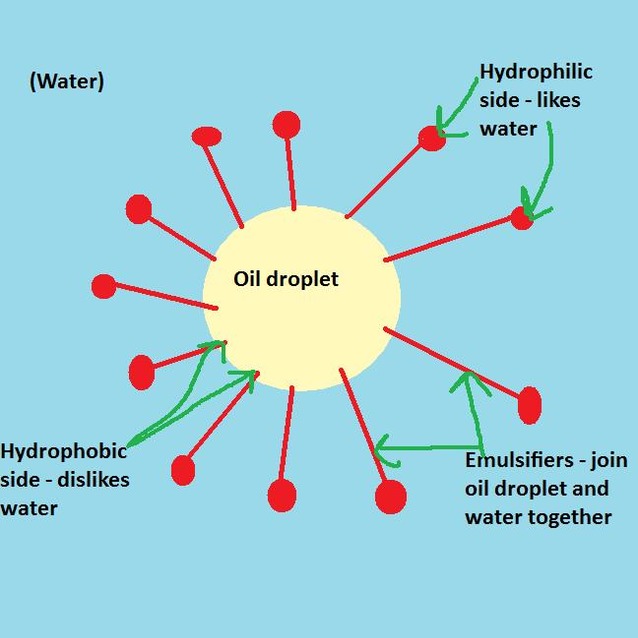
An emulsifier helps water and oil mix by suspending oil droplets throughout the water. They create EMULSIONS.

Emulsions are:
  • More viscous (thicker)
  • Better at coating things
  • Have a better texture
  • Because of this, emulsifiers are added to make products such as paint, mayonnaise, salad dressing, ice cream, milk and cosmetics.
  • Egg yolk is an example of a good emulsifier
Molecules of an emulsifier look like this:


The hydroPHOBIC tail repels water (just remember phobia means you're scared of something).

The hydroPHILIC head is attracted to water.

So when added to a substance contains oil and water the molecules surround the oil droplets, the tails in the oil droplet, repelling the water and the heads in the water.

This suspends the oil droplets throughout the water so they appear to be mixed, like below: